50mm f/1.8 AF Prime for Sony E & Nikon Z: Full-Frame
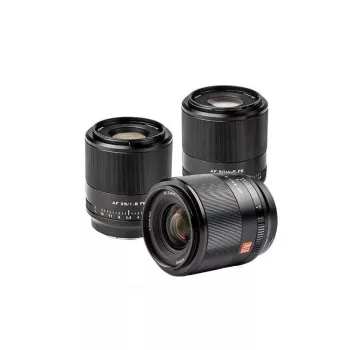
50mm f/1.8 Full Frame Auto Focus Prime Lens for Sony E-Mount & Nikon Z Cameras
A 50mm f/1.8 autofocus prime is a versatile choice for portraits, everyday street scenes, travel, and low-light shooting. With a bright aperture and a natural perspective on full-frame cameras, it can deliver subject separation, cleaner indoor images, and a compact kit that stays comfortable for long sessions. If you’re looking to simplify your setup without giving up image quality, a fast 50mm prime is often the lens that stays on the camera the most. For more guidance, see Sony FE 50mm f1.8 (SEL50F18F) review – Ricks Reviews.
What a 50mm f/1.8 prime adds to a full-frame kit
- Natural-looking perspective: Great for people, lifestyle, and documentary work without exaggerated distortion—faces and environments feel true-to-life.
- Brighter f/1.8 aperture: Helps maintain faster shutter speeds in dim interiors and evenings while keeping ISO lower for cleaner files.
- Shallow depth of field: Makes it easier to blur backgrounds and emphasize the subject for portraits, details, and product photography.
- Prime-lens discipline: A fixed focal length encourages deliberate framing and can improve consistency compared with a general-purpose zoom.
If you’d like a quick refresher on how focal length affects perspective and angle of view, Cambridge in Colour has a helpful guide: Understanding focal length and angle of view. For further reading, see Nikon Z6 Mirrorless Camera Review (2020) | Creative Hut.
Compatibility: Sony E-Mount and Nikon Z cameras
Before buying, confirm you’re selecting the correct mount version: Sony E (for full-frame E/FE bodies) or Nikon Z (for full-frame Z bodies). Modern mirrorless cameras can also benefit from firmware updates that improve communication with third-party lenses, autofocus stability, and overall behavior.
- Match the mount: Sony E and Nikon Z are not interchangeable; the correct version ensures proper fit and electronic communication.
- Update firmware: Keeping the camera current can improve AF responsiveness and reduce odd behavior in continuous autofocus.
- Check AF features: Eye detection, face detection, and focus-area modes can change how confidently the lens tracks a moving subject.
- Video expectations: Continuous AF transitions and tracking stability can vary by body, especially with third-party lenses.
Quick compatibility checklist before checkout
| Check item | What to confirm | Why it matters |
|---|---|---|
| Mount type | Sony E or Nikon Z version | Ensures the lens physically fits and communicates correctly |
| Sensor coverage | Full-frame coverage on the intended body | Avoids vignetting/cropping surprises on full-frame |
| Firmware | Camera firmware is current | Improves AF reliability and lens protocol compatibility |
| Shooting modes | AF-S/AF-C, eye/face detect availability | Determines tracking performance for portraits and action |
| Stabilization | Whether the camera has IBIS and how it’s configured | Helps reduce blur at slower shutter speeds |
For mount overviews and system details, see Sony’s E-mount lens pages and Nikon’s Z system overview.
Autofocus performance: what to expect in real use
A 50mm f/1.8 is typically used for people and everyday moments, so autofocus behavior matters as much as sharpness. In practice, results improve when AF mode and aperture match the scene.
- Portraits: Use eye-detection AF when supported, and consider f/1.8–f/2.8 to balance background blur and focus hit rate.
- Street and travel: AF-C with a flexible/zone area can raise your keeper rate for moving subjects and quick, candid moments.
- Low light: AF can slow as contrast drops; raising ISO slightly (for a brighter live view), using AF assist, or finding an edge with more contrast can help.
- Close focus: At minimum focusing distance, depth of field gets razor thin—stopping down a bit helps keep both eyes and eyelashes sharp.
Image quality priorities for a 50mm f/1.8
- Sharpness: Many 50mm primes are strong in the center even wide open; corners commonly improve at f/2.8–f/5.6, especially for travel scenes and architecture.
- Bokeh: Background blur depends on aperture shape, focusing distance, and background complexity. For smoother blur, move closer to the subject and increase the subject-to-background distance.
- Contrast and color: Skin tones and backlit scenes are good tests. A lens hood is often the simplest way to reduce flare and keep contrast in harsh light.
- Distortion and vignetting: Some vignetting at f/1.8 is normal. Many cameras correct this automatically for JPEG and pass correction data into RAW workflows, depending on body and lens support.
Best-use scenarios and starting settings
Handling, build, and workflow tips
Product spotlight: 50mm f/1.8 Full Frame Auto Focus Prime Lens for Sony E-Mount & Nikon Z Cameras
The 50mm f/1.8 Full Frame Auto Focus Prime Lens for Sony E-Mount & Nikon Z Cameras pairs a classic focal length with autofocus convenience for full-frame shooters who want a straightforward everyday prime.
In-stock picks on Esteemian
- 50mm f/1.8 Full Frame Auto Focus Prime Lens for Sony E-Mount & Nikon Z Cameras
- Nordic Lava Led Floor Lamp
- 42″ Grey Bathroom Vanity with Carrara Quartz Countertop
FAQ
Will a 50mm full-frame lens work on an APS-C Sony E or Nikon Z camera?
Yes, it will mount and function if the mount matches, but the field of view becomes tighter (about 75mm equivalent on a 1.5× crop). Framing feels more like a short telephoto, which can be excellent for portraits.
Is f/1.8 good enough for low light and background blur?
For many situations, yes. f/1.8 can significantly improve indoor and evening performance compared with slower kit zooms, and strong blur is easiest when you’re closer to the subject with more distance to the background.
Do Sony and Nikon cameras automatically correct distortion and vignetting?
Many bodies apply corrections for JPEG and embed correction metadata for RAW workflows, but support varies by camera model and lens profile. Check your camera menus and confirm the behavior in your preferred editing software.











Leave a comment